How Long Does Betrayal Trauma Last? A Realistic Recovery Timeline.
 T30 Team
4 min read·Awareness
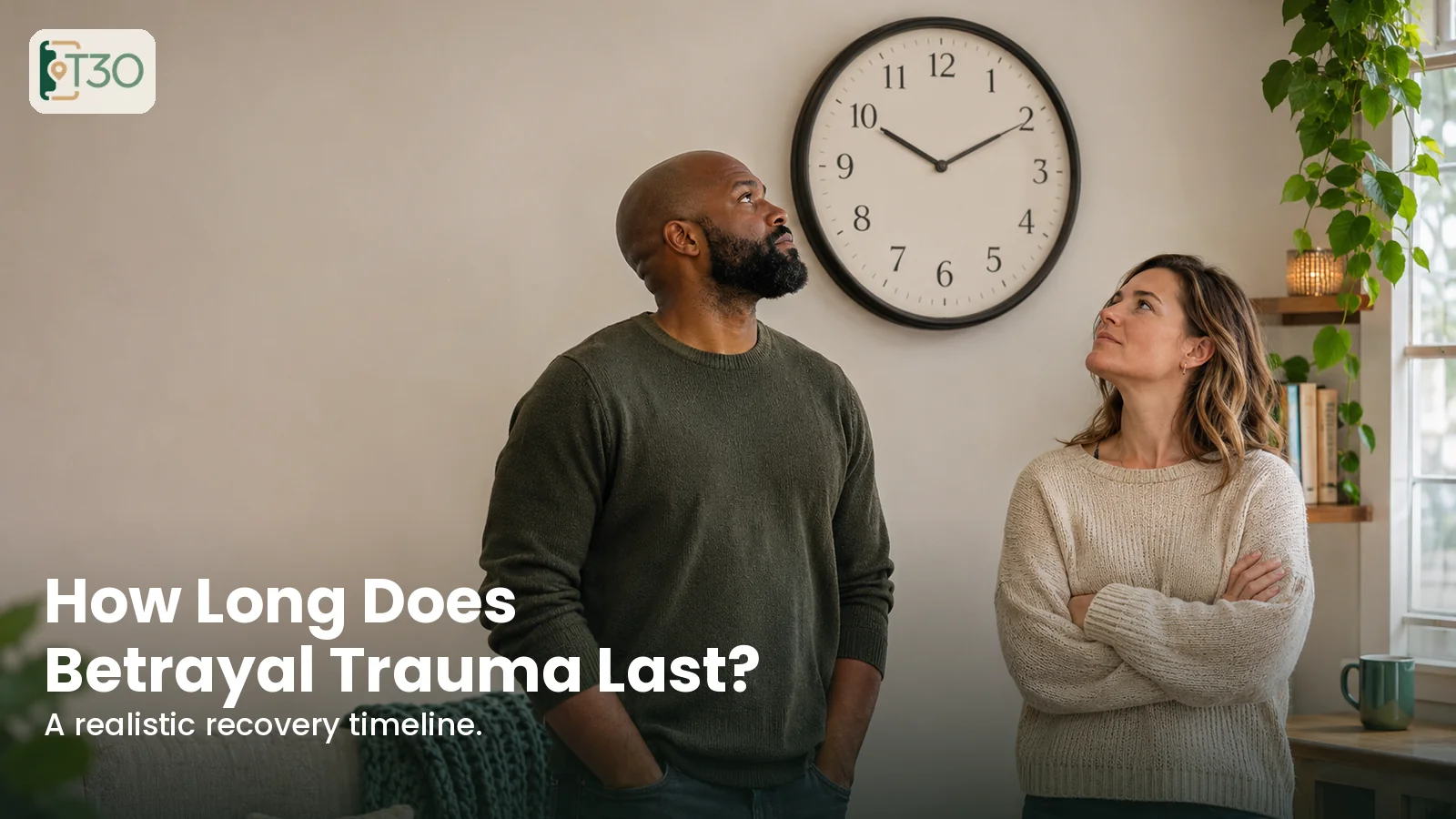
Nobody can give you a number, and anyone who does is guessing. Every relationship is different, and so is what happened and all of the other variables that sit at the intersection of betrayal. But there's one pattern we keep seeing: what took years to develop typically takes years to unwind.
The secrecy, the habits of hiding, the pattern underneath it. None of that was built last month, and none of it comes apart in a few weeks. If you've been told you should be "over this by now", there's no clock. Not for you. Not for anyone. And whoever is saying that, well, they lack an understanding that is paramount in lasting recovery and integrity.
Why no one can give you a single number
Think about what changes from one couple to the next: what happened and for how long, how it came out, whether the full truth is out, how the person who broke trust is showing up now, what support the partner has, and so much more. New discoveries restart the pain. We all want recovery to look like an S&P 500 stock when in reality it looks a whole lot more like the stocks during COVID.
If you're the person whose trust was broken, you may be on edge all day, replaying what you found, caught off guard by a song or a buzzing phone. You're not losing it. It's an awful reality, and a normal reaction to a real injury to you as a person. The hardest stretch can even come after the first shock wears off. And so it's difficult reality to accept that there is no singular number, but a general understanding of years. We've heard from other resources "1 year for every 3 years of acting out" but that's not a ratio we would abide by, it's just a super simplistic way to mathematize insane pain and uncertainty.
A rough shape, not a schedule
Not days. Not months. Years we would say. It tends to go like this, and it won't match any couple exactly:
- The first stretch is about safety and the truth. Getting the full story out, stopping the behavior, staying upright. Not the time for big decisions, but for scooping the water out of the leaky ship.
- The long middle is where trust gets built. Slowly, through what the person rebuilding trust does day after day. Triggers still hit, and a good week can be followed by a terrible day. That's part of it. This is usually years and can be undone in a moment with a relapse, slip of integrity or many other things. It's where therapy happens, the hard work, the consistency. It's where you stay to patch the holes to the ship and even start tending to the pieces that are broken.
- The long tail is when the pain loses its grip. Many partners tell us it gets lighter and shows up less often. We can't promise that, and we won't but this is the season where you can "breathe". Where there isn't a fear of the ship crashing to the bottom of the ocean but rather a hope that things could actually not only be good again, that they could even get...better?
What speeds things up and what resets the clock
What helps: the full truth out early, once; what's said matching what's done, over and over; empathy instead of defense; and a partner with support of their own, like a therapist who understands betrayal. Patience from everyone helps too. What resets the clock: new lies, new discoveries, and "aren't you over this yet?"
- If you're the person rebuilding trust, here is the fun little secret: you, and only you. Yes, you! You, are the only person that can actually help speed up your partners healing. Tell the truth early, do what you said, and keep doing it when nobody's checking. Asking "how much longer?" tells your partner you're counting down. Asking "what would make today feel safer?" tells them you're paying attention. Which one do you think is going to internally get them to where you both want to go?
- If you're the person whose trust was broken, you're not behind. Don't compare your timeline to a friend's or a forum's. A bad day doesn't mean zero, and a good day doesn't mean the pain won't come back tomorrow. Find a community that is safe, supportive, and willing to listen to all the crazy things that fill your head and heart during the most difficult season of your life.
- Get support of your own. This is too much to carry alone, for either of you. We encourage you to join our T30 Community here that is built for couples going through this season.
Where T30 fits
T30 can't speed healing up or promise an outcome, and it isn't treatment. What it can do is make the daily part visible. Ascension by T30 gives the person rebuilding trust a record of follow-through, one check-in at a time, and Anchored by T30 gives the person whose trust was broken a place of their own to notice what they're feeling. The Emotion Journal is never shared with a partner.
If you're in crisis or feel unsafe, please reach out to a licensed therapist or a trusted local resource. This article is educational and isn't a substitute for professional support.
Source: The Gottman Institute, The Grief of an Affair
T30, the recovery hub of hope.