Why a Polygraph Can Be One of the Best Tools in recovery...but also life.
 T30 Team
5 min read·Support
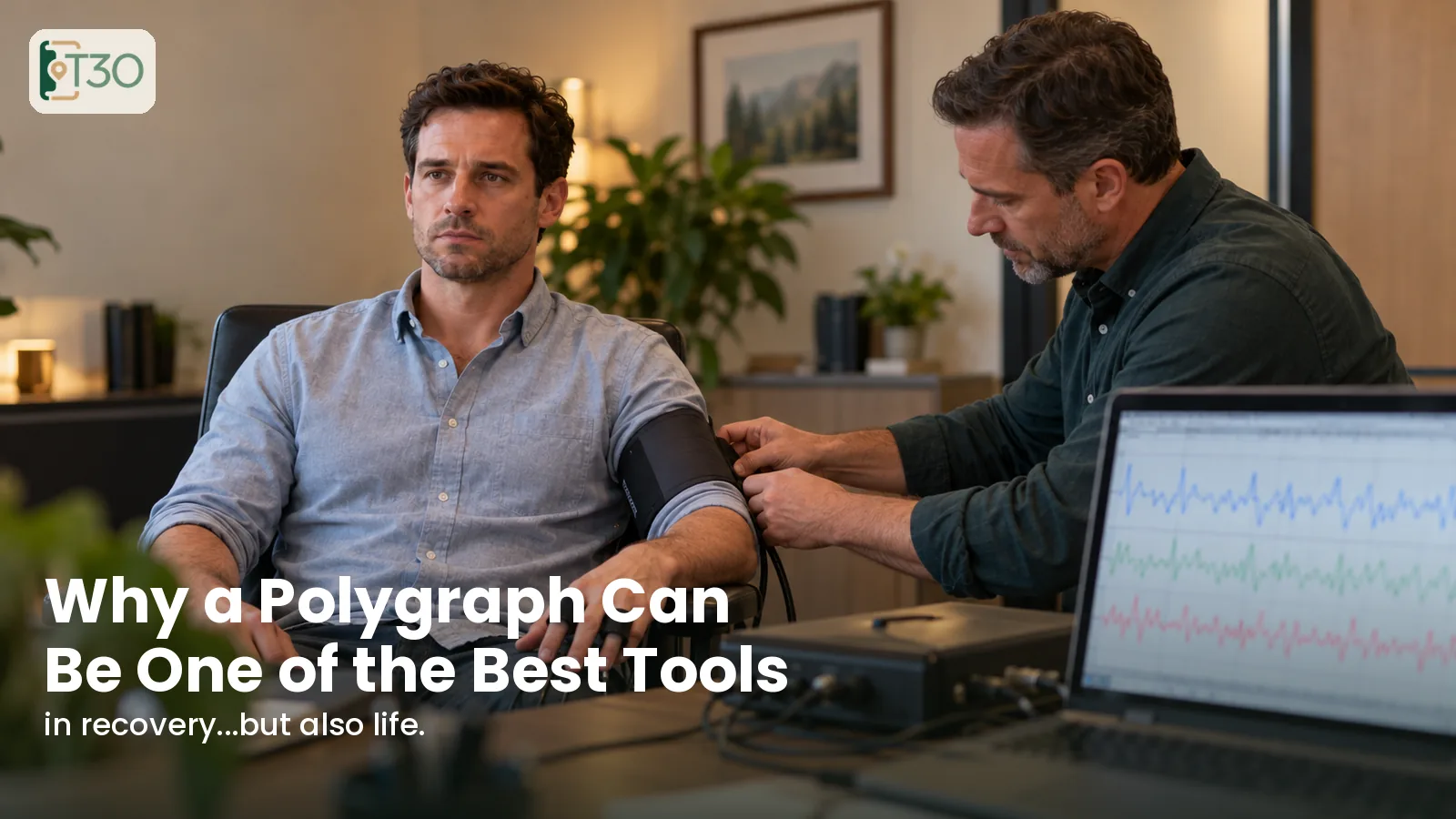
A polygraph is not a magic lie detector, and it doesn't need to be one to be one of the most useful tools in sexual addiction recovery, and really in life. As someone who has taken 12 to date, yes TWELVE, I am a huge proponent. Why would I take so many? Am I that much of a liar? I definitely don't think I am, but that's a blog post for another day. What it does best is change what honesty costs and it also answers this question: Does this person actually have the ability to tell the truth? Here is why we think that makes it worth it, and where its limits are.
It changes what happens before the test
Think about what a polygraph does to a secret. Knowing you will be asked, out loud, in a room, whether there is anything you have left out, changes the mental math. If it's important to you. Many people come to the first test with something they have been holding back and decide to say it first. That is the point.
The National Research Council reviewed the science in 2003. It found the polygraph can tell lying from truth-telling well above chance, but well below perfect. It also said the test can have real value in getting people to admit things and in deterring them, and that this value comes from people's belief in the test rather than from its proven accuracy. In our experience that means people who expect to be tested say more beforehand. That is a feature, not a bug. For those with integrity issues of any kind, not just addiction, the ability to tell the truth is work in and of itself. For decades, lying has been the baseline for operating. Polygraph is that tool that can help speed up the process of telling the truth more consistently.
It takes the investigation off the partner
For the person whose trust was broken, the worst part of the early weeks is often becoming the detective because you're looking for safety. Checking phones, replaying stories, asking the same question five different ways, and never knowing whether this version is the real one. It's an awful reality. It is exhausting and it's not a role anyone should have to take, nor one that they want to take. And just information for those that have broken trust, your partner doesn't want to feel these things. They don't want to have the sensation of "control" or "micro-managing" behaviors, but when your world has literally just been shattered and you're now living with someone who is 100% NOT who they actually are...what can we actually expect them to do early on?
A polygraph run by a trained examiner, and we'll give our recommendation below, alongside a therapist, moves some of that weight. The question "did you tell me everything?" gets asked and answered somewhere that isn't the kitchen at 11 p.m. When the answer is clean, the partner gets something no apology can give: a legitimate record. When it isn't, the truth surfaces in a setting with professionals present, not in a blowup.
IT's a gift
At T30, the frame we have around polygraphs is this: it's an absolute gift. A passed polygraph, especially multiple ones, shows the partner a commitment to radical honesty. It's also extremely anxiety producing to do one, so the fact that the person taking it is submitting to this anxiety, and pushing themself through it is such a move of high integrity and character that it really does start to change the way the partner experiences them over time. For someone who has lied and manipulated the truth for so many years, is there really any better gift you can give someone than a passed polygraph that says "Yes, I told the truth no matter how uncomfortable it was and no matter how much it costs in actual dollars" We don't think so.
Who we suggest
The criticism is serious. The same National Research Council report rated the quality of the research as low and warned that laboratory results likely overstate how accurate the test is in real life. Stress, shame and trauma can make a true answer look like a false one, and a person with a history of being disbelieved may react to the room itself. Results are not accepted as proof in many courts. And no study we know of shows a polygraph by itself produces lasting change. It is like anything else in this space, a tool.
So the person running it, is the most important thing and for us there is only one person who we really trust to send referrals to: Stephen Cabler out of Houston, Texas. You can see his information here at his website. With decades of experience, Stephen's heart is for men who at their core don't want to lie, they just don't know how. He isn't in the "gotcha" business in trying to fail people, he is in the "trust business", and wants to build trust with men so that they can build trust with their partners.
Does a polygraph ultimately prove someone is telling the truth? Not all the time. It measures the body's response to questions, and research puts its accuracy well above chance but well below perfect. Treat a result as information to talk through, never as 100% proof. It should be a data point in a long string of experiences felt that point to change in the person.
Why do people recommend it if it isn't perfect? Because knowing it's coming leads people to say more beforehand, and because it moves the question "is there more?" out of the relationship and into a structured setting.
What if my partner fails? It doesn't mean the relationship is over. Stress and shame can affect results. Lying can also, as well. It means there is something to look at together with your therapists, and why if radical honesty is all that is required to pass, they didn't.
If you're in crisis or feel unsafe, please reach out to a licensed therapist or a trusted local resource. This article is educational and isn't a substitute for professional support.
Sources: National Research Council, The Polygraph and Lie Detection (2003); Gannon et al., An Evaluation of Mandatory Polygraph Testing for Sexual Offenders in the United Kingdom, Sexual Abuse (2014)
T30, the recovery hub of hope.