Is It Cheating If It's Online? DMs, OnlyFans, Micro-Cheating, and AI Companions
 T30 Team
4 min read·Insights
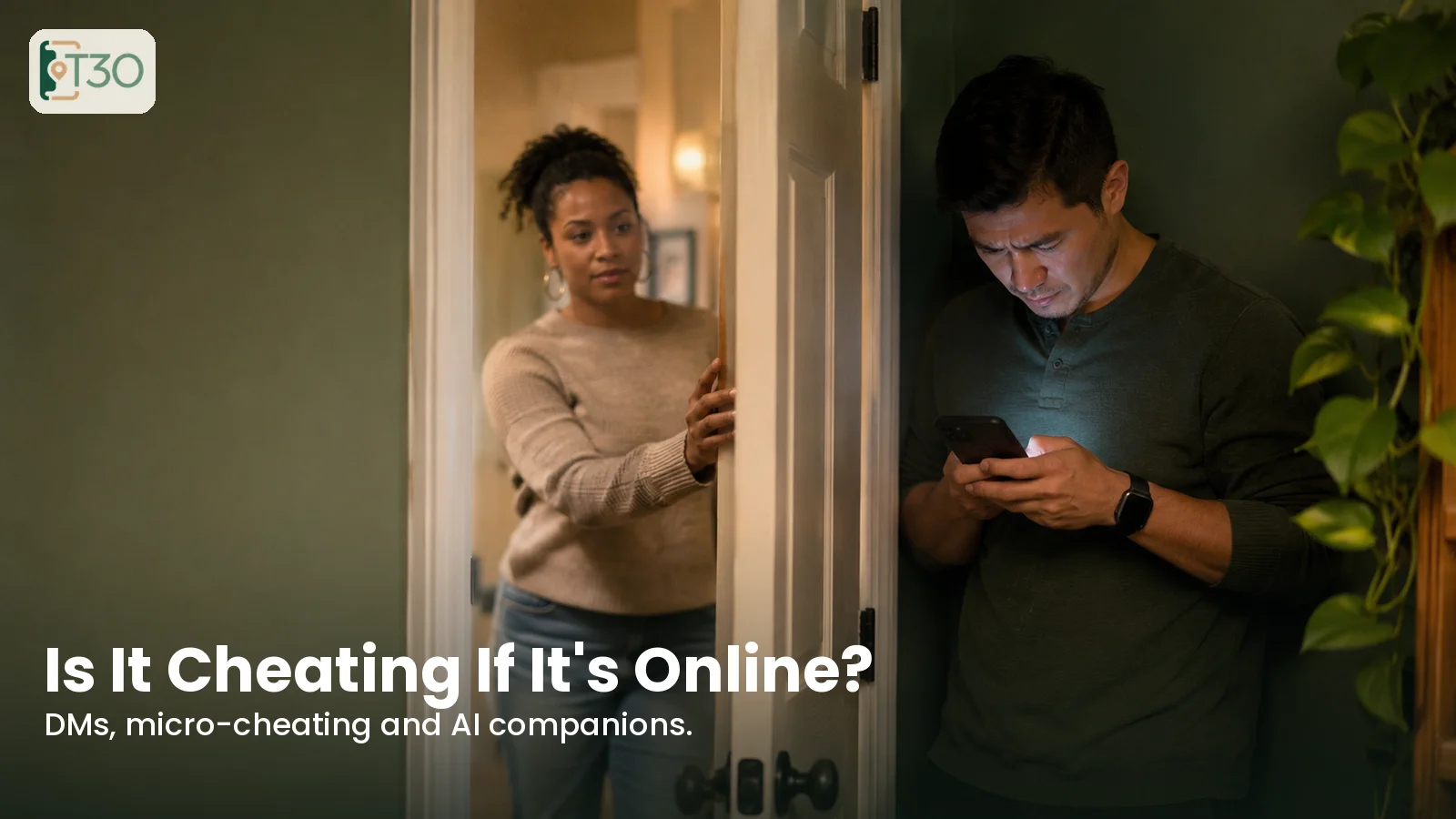
Short answer: yes. In our opinion, if it's online and hidden from the person you're committed to, it is cheating. But we'd rather start somewhere else, because the argument over which behavior counts is the wrong one.
DMs, a paid subscription to a creator, a "harmless" thread with someone from work, an AI companion that says it loves you. New apps, same question. There's no rulebook everyone agrees to, so let's look at what's underneath.
The question under the question
The heart of this is integrity, not the platform. Online. Offline. It's irrelevant to answer that question. Integrity is acting the same whether or not your partner is watching. Every example in this debate shares one feature: someone is doing something online they'd change or hide if their partner were sitting next to them.
That's true across the board. Ask why a thread is so easy to hide. Attention, flirting, the feeling of being picked: that's being given away somewhere your partner can't see, and often what hurts most to find isn't the words, it's the hiding. That's what we see in partners of sexual betrayal, by the way: the hardest part of recovery from infidelity is more often the lying, hiding, and manipulation rather than the interactions with other people/things. A message isn't the problem, but a conversation you'd delete or angle your phone away from is. Paid content isn't the problem for a couple who talked it through and agreed (this has it's own problem if that's the point), but following or messaging a creator while hiding it is a problem. Micro-cheating, like a contact saved under another name, is small, but nobody goes from full openness to a big betrayal in one step. And with AI companions, a 2026 study from BYU's Wheatley Institute and the Institute for Family Studies found most regular users said it mattered that their partner not learn the full extent of their use. If it were nothing, it wouldn't need hiding.
Three tests that cut through the noise
- Would I do this with my partner sitting next to me? If the answer changes the moment they sit down, that's your answer.
- If they read every message tonight, would I be okay? Not "would I get in trouble." Would I be okay.
- What if it were reversed? If your partner did this behind your back, would you call it cheating? Be honest.
What to do with the answer
If you're the one who found it, you're not crazy, and it isn't "just online." You found out you weren't told the truth. You get to name how it landed, and to ask for clear agreements from here on, said out loud. We believe at T30 things like these are betrayals. Maybe the severity is different, but it's a betrayal none the less.
If you're the one who did it, we get it. It felt like nothing: no hotel room, nothing to explain. That's exactly why it's easy to talk yourself into it. The way out is the same as for anything hidden: tell the truth early, end it, and don't shrink it when your partner reacts. Minimizing the hurt is a second hurt. If you can't stop on your own, take that to a counselor. And if you never defined it as a couple, define it now, before the next thing.
Where T30 fits
3 Circles in T30 lets you write down your own limits, like apps, accounts and situations that pull you off course, and share them with someone you trust. Ascension by T30 check-ins give the person rebuilding trust a place to say what they did and what they felt that day. T30 doesn't prove honesty or prevent behavior, and it doesn't replace therapy.
If you're in crisis or feel unsafe, please reach out to a licensed therapist or a trusted local resource. This article is educational and isn't a substitute for professional support.
T30, the recovery hub of hope.